Rasul Medal announces shortlist of nominees for second edition
TEHRAN - The initial list of nominees for the second edition of the Rasul (PBUH) Medal, which is presented alongside the Mustafa (PBUH) Prize to young scientists from the Islamic world under the age of 40, has been finalized.
The shortlist comprises four nominees in engineering sciences, four in mathematics, four in computer science, eight in biological and medical sciences, two in chemistry, and two in physics. The award ceremony for the final winners is scheduled to be held in December.
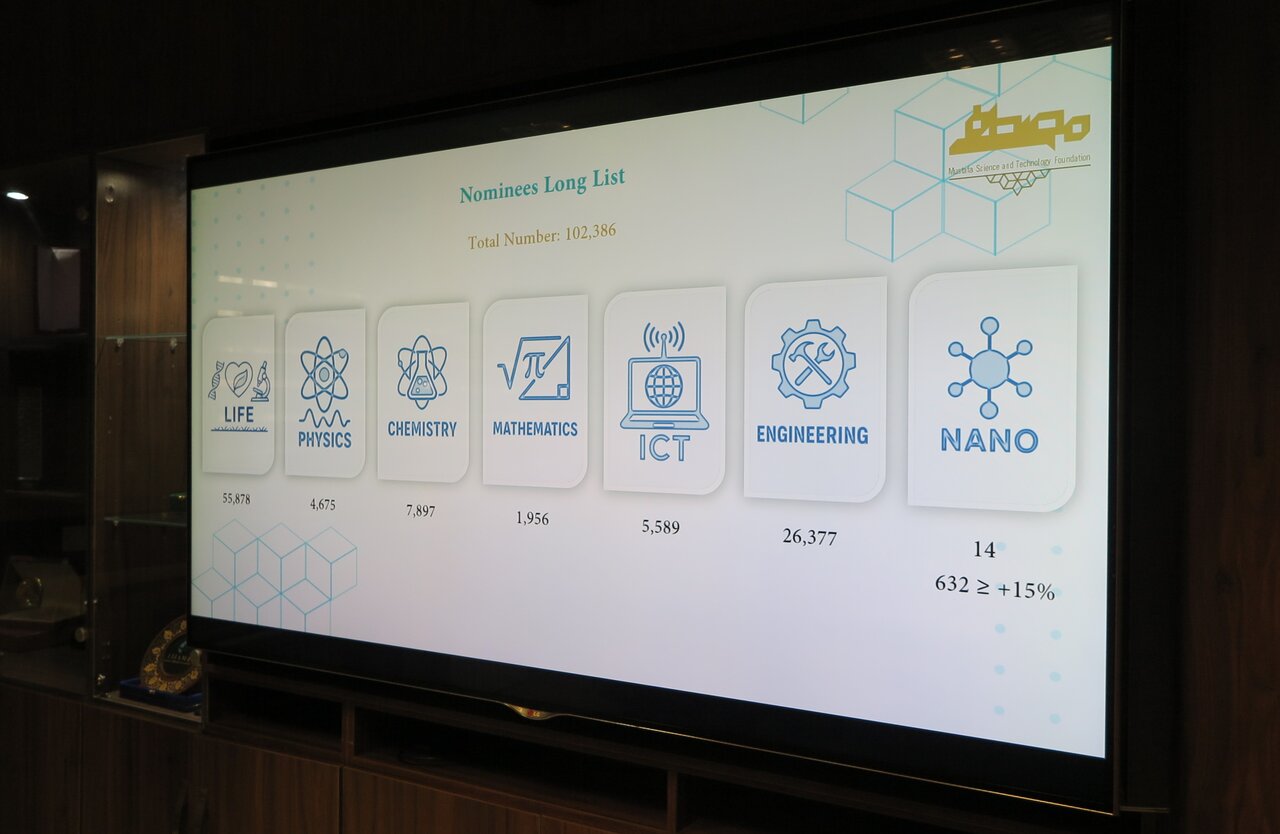
The initial list considered for the Rasul (PBUH) Medal included more than 100,000 candidates across seven scientific fields. The biological and medical sciences category accounted for 55,878 candidates, followed by 4,675 in physics, 7,897 in chemistry, 1,965 in mathematics, 5,589 in computer science, and 26,377 in engineering sciences. In addition, 14 candidates in the field of nanotechnology met the required criteria to be included in the initial list.
Following a review of the outcomes of previous meetings, the judging panel selected the nominees for the shortlist. Accordingly, four nominees were selected in engineering sciences, four in basic sciences, four in mathematics, four in computer science, and eight in biological and medical sciences.
Under the regulations governing the medal, the Rasul (PBUH) Medal secretariat issued a call last December for scientists under the age of 40 residing in Islamic countries. Scientific institutions and prominent scientists had until January 20, 2026, to submit nominations for the medal.
Symbol of scientific excellence
In order to appreciate prominent scientists and provide the ground for scientific cooperation and development worldwide, the Mustafa Prize was established in 2012 as a symbol of scientific excellence at the international level.
The Mustafa Prize, a top science and technology award, is granted biennially to the top researchers and scientists of the Islamic world in three categories: “Life and Medical Science and Technology”, “Information and Communication Science and Technology”, and “Basic and Engineering Sciences”.
The Prize is granted to works deemed to have improved human life, have made tangible and cutting-edge innovations on the boundaries of science, or have presented new scientific methodology.
Ali Akbar Salehi, the head of the scientific working group of the Mustafa Prize, said in August that the scientists targeted by the award include both Muslim and non-Muslim researchers living in Islamic countries, as well as Muslim scientists residing and working in non-Islamic countries.
“Therefore, it is in this context and from this perspective that we use the term ‘scientists of the Islamic world.’ We aim to identify and introduce talented scientists who are not widely known—not necessarily unknown in absolute terms, but relatively unknown to our own community—and bring their achievements to greater public attention, enabling these scientists to gain greater visibility on the global scientific map,” he said.
He added that, for example, among the 22 scientists who have received the prize to date, laureates have come from Bangladesh, Pakistan, India, Turkey, and Singapore.
“This demonstrates that geography should not be a barrier to the recognition of scientists, and the Mustafa Prize is precisely committed to advancing this goal,” he said.
“One of the objectives of the Mustafa Prize Foundation is to establish a scientific network. The goal is not merely to introduce the prize laureates, but also to connect scientists, enabling them to be identified while creating an environment conducive to synergy, collaboration and mutual scientific exchange.”
He went on to say that the foundation has adopted various mechanisms and initiatives to achieve this objective, many of which are known by their Latin acronyms in connection with the Islamic world.
These include the Science and Technology Exchange Program (STEP). The STEP initiative comprises several components, including STEPOL, which focuses on science, technology and innovation policymaking.
In addition, the foundation organizes “Seasonal Schools,” which are held at different times of the year and focus on specific scientific topics, bringing together experts and individuals interested in gaining knowledge in those fields.
Another initiative is the Faculty Mobility in Islamic Countries (FAMIC) program, which aims to facilitate the mobility and exchange of university faculty members among Islamic countries, with the Mustafa Prize Foundation serving as a facilitator. For example, this year, following an open call and despite the circumstances and developments that arose, two of the 42 applicants were selected to attend a program at a university in Pakistan.
He further noted that another initiative is the Young Scientists Fellowship Program (YSFP), which provides scholarships and financial support to young scientists and researchers from Islamic countries, enabling them to travel to scientific and research centers for training and skills development.
The foundation also operates a scientific observatory that monitors emerging frontiers of knowledge and major scientific developments worldwide. The observatory’s activities also result in the publication of specialized reports and publications on scientific developments.
Mehmet Toner, professor of biomedical engineering at Harvard University from Turkey; Vahab Mirrokni, adjunct associate professor at the Courant Institute at New York University from Iran; and Mohammad K. Nazeeruddin, professor of chemistry at the EPFL, and Sion Campus, from India, were the winners of the 6th Mustafa Prize in 2024.
Leave a Comment